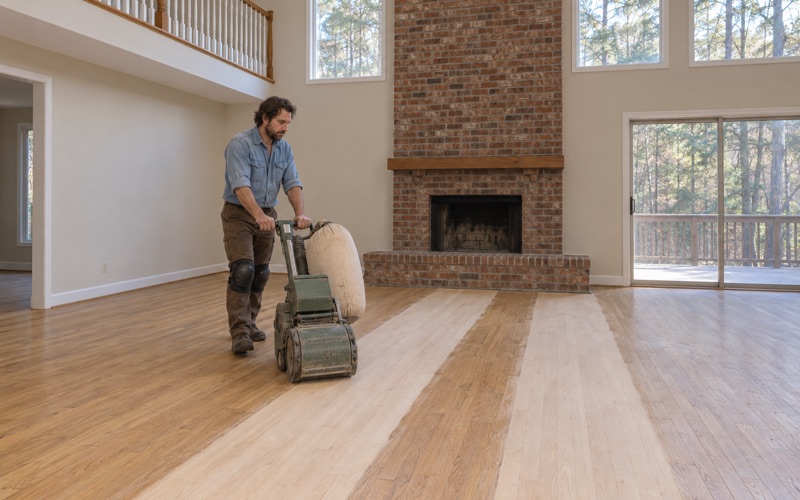
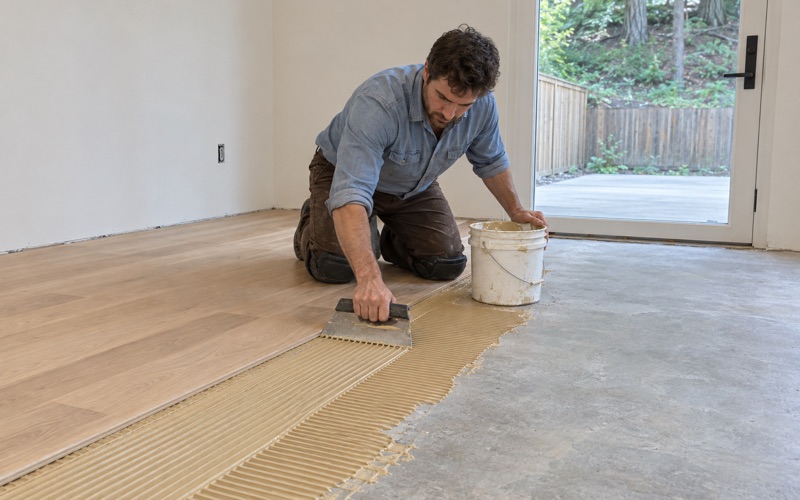
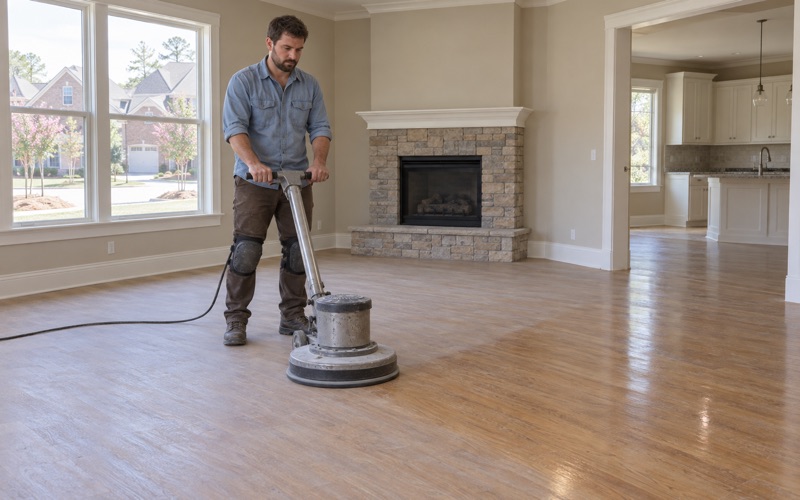
Smyrna Wood Flooring has worked on wood flooring in Powder Springs for more than 20 years, sanding, refinishing, repairing and installing hardwood in houses of very different ages. Most of what we see is oak strip or plank put down in the last few decades. A smaller number of floors are much older, and those call for a slower, more careful approach than a standard sand-and-finish job.
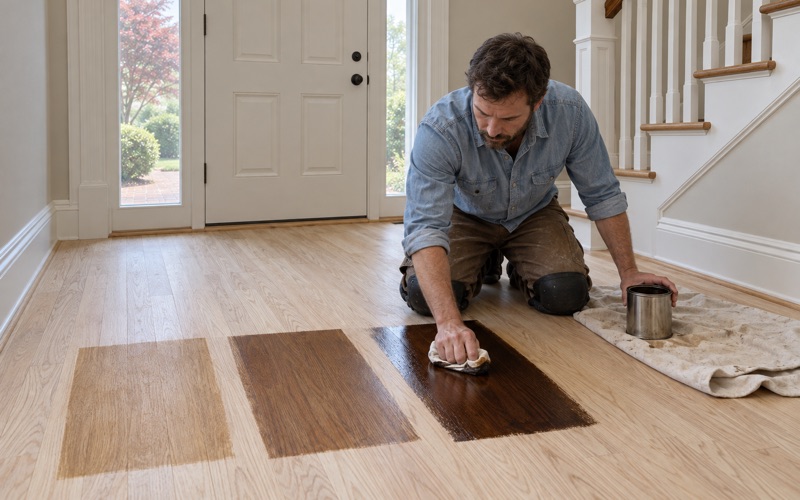
Every job starts on your floor rather than in a catalog. We read moisture with a meter before judging any cupping or crowning, measure how much wood is left above the tongue before promising a refinish, and test old coatings before a sander touches them. Stain samples go down on your own boards, in your own light, so the color you pick is the color you get.
This page is mostly about the older end of that range: a handful of early houses in the downtown core, how their floors have survived changes of use, and what it takes to keep original boards rather than replace them. Near the end we turn to the far larger stock of newer homes, where the work is more familiar but still depends on reading each floor first.
The Old Houses of Marietta Street
A Short Row of Early Houses
Powder Springs was incorporated as Springville in 1838 and took its current name in 1859, after the seven springs within the city limits. The Seven Springs Museum has documented a row of early houses along Marietta Street downtown, several of which have outlasted more than one owner and more than one purpose. Their floors carry that history in patches, repairs and changes of direction.
The list includes the Bodiford House at 4355 Marietta Street, the Camp-Boyd House at 4279 from about 1905 to 1910, the Magnolia House at 4371, and the Florence House at 4405, built around 1915. The Leake-Lovinggood House at 4494 dates from 1913. Each has been lived in, remodeled or repurposed, which is exactly what leaves marks on a wood floor.
Old Floors in a Newer City
These houses are unusual here. Census estimates show most of the city’s housing was built after 1960, with the largest share from the 1990s, and the city’s own planning documents describe a historic town center with newer subdivisions radiating out from it. So a pre-1920 floor downtown is a different job from almost anything else we sand in town.
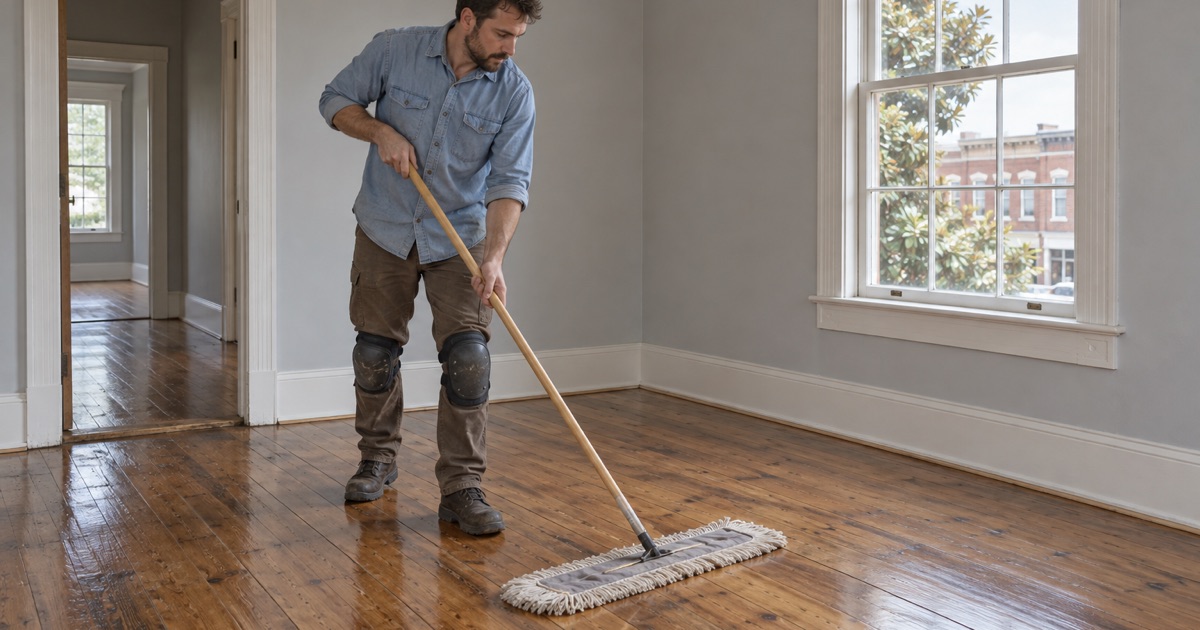
An older floor may have been nailed by hand, finished with shellac or paste wax long before polyurethane was common, and patched several times with whatever lumber was on hand. It rewards the kind of attention a museum would give it. It punishes a drum sander run through the grit sequence you would use on a 1990s floor.
What We Check Before Anything Else
In any home built before 1978, we confirm the build year and check for painted surfaces before sanding, since old paint on floors, baseboards or thresholds changes how the work has to be done. We also test the existing finish in a corner. Old shellac or wax under a newer coat will stop a modern finish from bonding, and it is far better to learn that on a test patch than across a whole room.
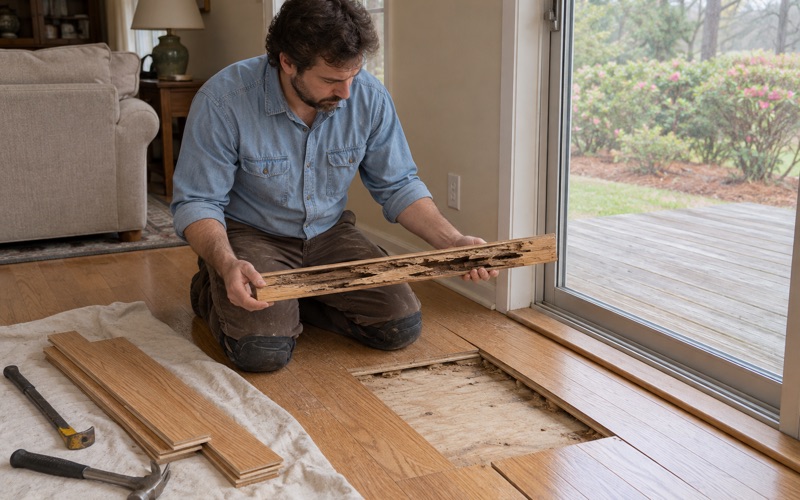
Next comes a moisture meter reading and a close look for soft spots, hollow spots and the mud tubes that point to subterranean termites. Older framing has had more years to meet water and insects. If a pest control company needs to treat first, we wait for that treatment before any damaged board is cut out and replaced.
Looking for wood-flooring closer to Westview? See Westview Wood-Flooring.
Original Boards in the Bodiford House
One Front Room That Kept Its Boards
The Bodiford House at 4355 Marietta Street is now home to the Seven Springs Museum, which opened there in October 2015. According to the museum, the floors in the front room on the right are original boards. That single room is a useful reminder that original flooring often survives in pieces, one room kept while the rest of the house was changed around it.
We see the same pattern in older houses generally. A front room was used for company and spared the heaviest wear, while kitchens and back rooms were torn up, covered or replaced over the decades. When an owner asks whether an old floor is worth saving, the answer often depends on which rooms still hold their first boards and how thick those boards remain.
Hand-Hewn Beams and a Queen Anne Remodel
The museum describes the Bodiford House as starting out as a two-story, four-room house with hand-hewn beams dating to the 1800s, later given a Queen Anne design with two cross gables, a corner tower and a wraparound porch. Its original beams and foundation can still be seen under the house. The structure beneath that front room is as old as the boards on top of it.
A remodel on that scale usually means new rooms joined to old ones, and new floors meeting old floors at a doorway or along a line across a room. Those joints are where we slow down. Board widths, thicknesses and the direction of the run can all shift right where one era of a house meets the next.
Reading an Original Room in Your Own House
If your older home has a room like that, we begin by lifting a floor register or a threshold to see a board’s profile and the wood remaining above the tongue. Heavy past sanding leaves little margin, and an original board that is sanded through cannot be put back. Sometimes the right call is a light screen and recoat rather than a full sanding.
We also look at the patina before recommending any stain. Decades of light and wear give old boards a color that new wood will not match on day one, and a floor sanded to bare wood loses it. Some owners want that fresh look, while others want the old color kept. Either choice is reasonable once you know what is being traded.
Houses Moved, Enlarged and Put to New Uses
The Magnolia House and the 1930 Road Widening
The Magnolia House at 4371 Marietta Street, also known as the Camp-Lawler House, dates from the early 1900s. In 1930 it was rolled to its present position to make room for the widening of the road. It later went through extensive expansion and renovation, and it now serves as a special events facility.
Moving and expanding a house of that age leaves traces a floor mechanic learns to expect: boards that change direction at an addition, patches where walls or doors once stood, and seams where old framing meets new. On a home with that kind of history we map those seams before sanding. A drum sander crossing an uneven joint will dig in, so height differences get addressed first.
Boarders, Renters and Businesses at the Camp-Boyd House
The Camp-Boyd House at 4279 Marietta Street is a smaller Victorian built about 1905 to 1910, with decorative spindle work in the gable. The museum notes that it housed boarders, renters and businesses through the years. A house that has served that many people tends to wear in a very particular way.
Rooms used as shops or offices collect traffic lanes along a path from the door, while rented rooms may have been carpeted, painted or partitioned. When we open up a floor with that past, we expect tack-strip holes, staple rows, old paint and mismatched patches. We fill the holes and staple rows rather than hiding them under stain, and we replace boards only where they are beyond saving.
From Private Home to Funeral Home at the Florence House
The Florence House at 4405 Marietta Street, built around 1915, is a Queen Anne Victorian house that now serves as a funeral home. A house that moves from private rooms to public use has to handle more visitors, more furniture moves and more cleaning. Floors in that setting need a finish chosen for durability as much as for looks.
For any older house now used commercially, we talk through the finish before the color. Waterborne polyurethane dries clear and fast, an oil-modified polyurethane builds a warmer amber tone, and a hardwax oil can be spot-repaired but asks for more upkeep. The sheen level matters too, since a lower sheen hides the scuffs a busy room collects.
Keeping and Patching Original Floorboards
Deciding Which Boards Stay
Keeping original boards starts with an honest board-by-board survey. We mark splintering, deep pet urine stains, water stains that have turned black, and any board with termite damage or powderpost beetle holes. Most old floors carry a few of these, and most can still be saved around them. The goal is to replace as little as possible while leaving a floor that is sound underfoot.
We do not guess at the species of an original floor, and we do not assume it from the age of the house. A sample board pulled from a closet or cut from a damaged area tells us the wood, the width and the thickness. That is what we match against, whether the replacement comes from salvage or from new stock milled to fit.
Weaving In New Boards Where Rooms Changed
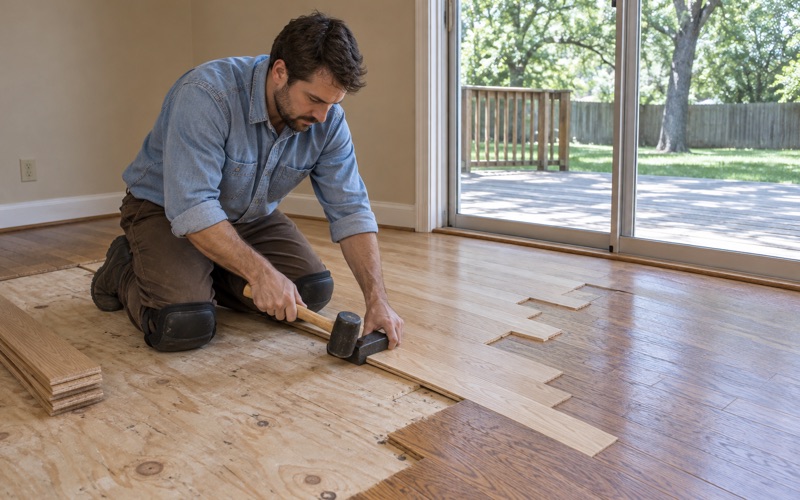
Where a wall came out or a doorway moved, an old floor usually shows a strip of mismatched boards or a gap filled with something else entirely. We cut those out and weave replacement boards into the surrounding field, staggering the end joints so the repair does not read as a straight seam. Each tongue and groove is fitted board to board rather than face-nailed wherever that can be avoided.
Color matching comes last. New wood starts lighter than a board with a century of patina, so we lay stain samples on the patch and on the old boards side by side before finishing the whole room. The aim is for a visitor to see one continuous floor rather than a repair.
Newer Floors Across the Rest of Powder Springs
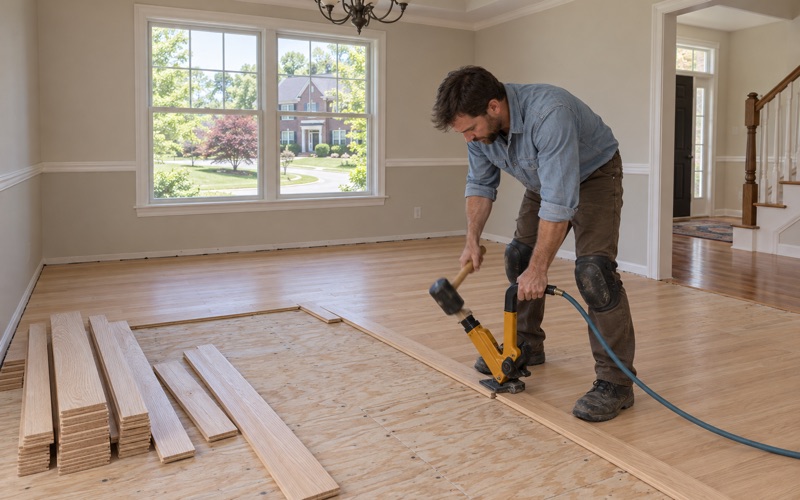
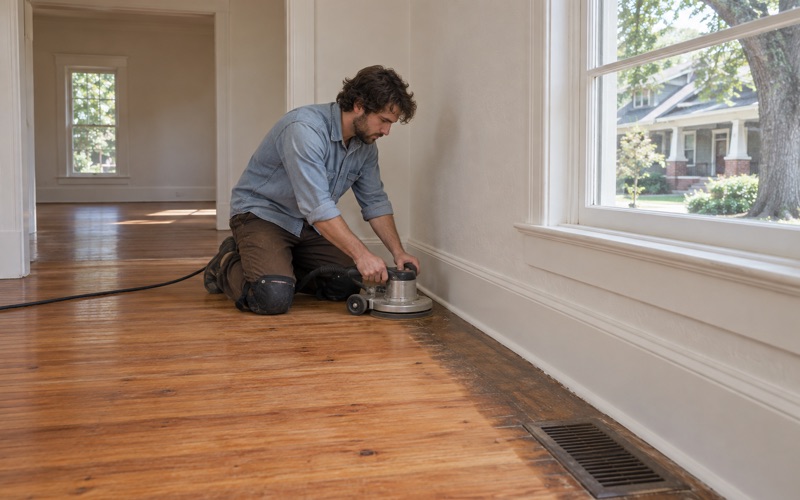
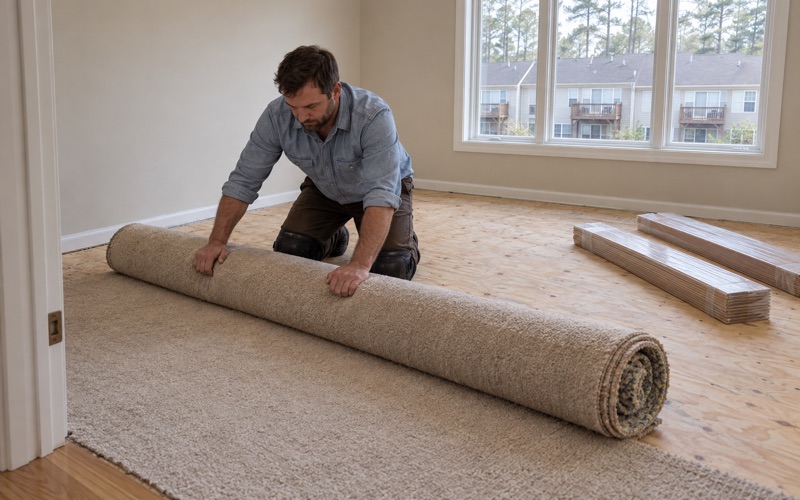
Outside the downtown core, the city’s housing runs from 1960s ranch homes through the 1990s and 2000s subdivisions that hold a large share of its homes. In the ranches, oak strip flooring often sits under wall-to-wall carpet, and we sand and refinish it after pulling the carpet pad and tack strip. In site-finished oak from the 1980s and 1990s, we check the wood above the tongue before recommending a refinish over replacement.
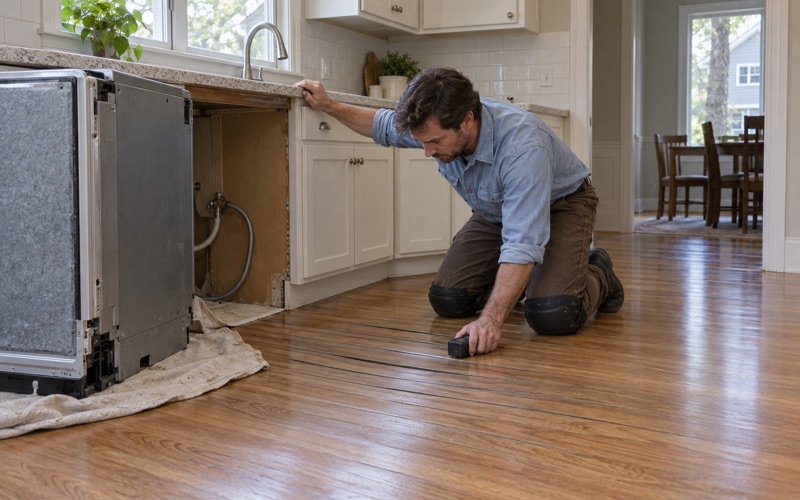
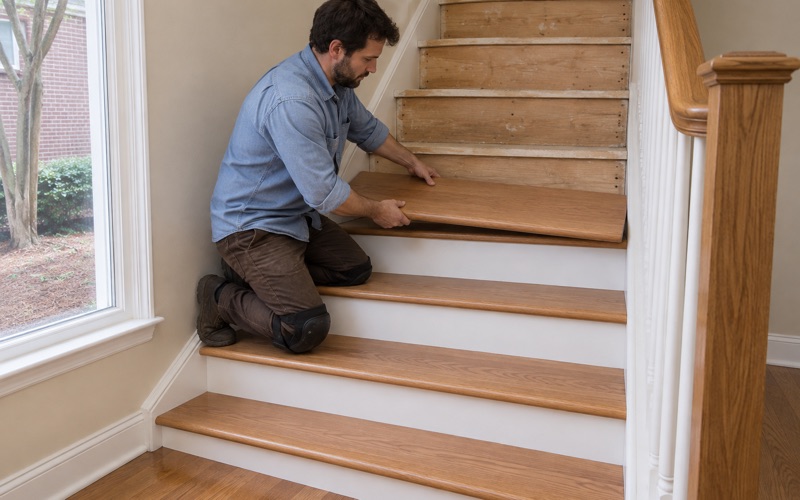
Humid Georgia summers bring cupping, and we read it with a moisture meter and find the source before anyone sands the crown flat. Water from a washer, dishwasher or supply line gets traced, dried and measured before any board is replaced, with the readings documented room by room for an adjuster. Stairs are quoted tread by tread, with refinishing and new treads priced separately.
- 20+ Years on Wood Floors
- Moisture Readings Before Repairs
- Stain Samples on Your Floor