
Smyrna Wood Flooring provides hardwood floor repair in Smyrna, GA, backed by more than 20 years of work on wood floors, serving surrounding cities including Vinings, Fair Oaks, Mableton, Marietta and Austell. We fix squeaks, gaps, soft spots, stains and broken boards with matched wood woven into the floor you already have, so the repair blends in instead of standing out as a patch.
Most floors do not need replacing because one part of them has failed. A cracked board by the back door, a dark stain where a plant sat, or a squeak on the path to the kitchen can each be fixed on its own. Our job is to find out why the damage happened, repair it at the source, and leave you with a floor that looks continuous again.
Every repair starts with a diagnosis rather than a saw. We read moisture where boards are lifted or stained, check the subfloor and joists where the floor gives, and look at how the boards were fastened. Skipping that step is how the same repair ends up being done twice.
Finding What Went Wrong
Loose Boards and Squeaks
Squeaks come from boards rubbing against each other or against loose fasteners, and they get worse as a floor ages and dries. Where there is access from a basement or crawlspace, we often fix them from below by drawing the subfloor tight to the boards. Where there is not, we use small fasteners driven from above and filled to match.
Loose boards that rock or lift are usually a fastening problem too. We refasten them with flooring cleats or trim screws suited to the thickness, so they stay down rather than working loose again after one season.
Board Gapping and Seasonal Movement
Gaps that open in winter and close in summer are normal wood movement, driven by the swing between dry heated air and humid Georgia months. Filling those gaps in winter can force the boards into buckling once summer humidity returns, so we leave seasonal gaps alone and explain why.
Gaps that stay open all year, or keep widening, are different. They can point to a floor installed too dry, a long-term moisture problem, or fasteners that have let go, and those we diagnose and repair properly.
Soft Spots and Hollow Spots
A soft spot that gives underfoot usually means a failed section of subfloor, rot from an old leak, or a damaged joist. A hollow spot on a glued floor can mean the adhesive has let go. Both need the floor opened so the cause can be seen and repaired.
We cut out only as much flooring as the repair needs, fix or replace the subfloor and any damaged joist, and relay the boards. Putting new wood over a weak subfloor just moves the soft spot a few inches.
Replacing Damaged Boards
Cutting Out and Weaving In
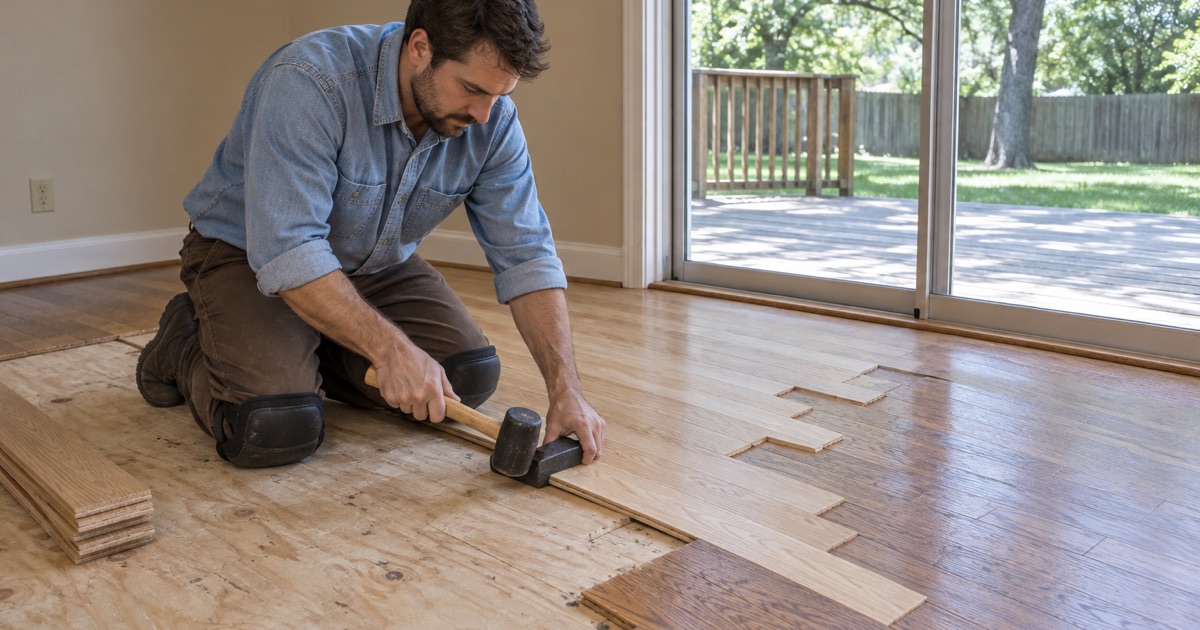
A proper board replacement is not a square patch. We cut the damaged boards out along their length and weave new ones into the floor, staggering the end joints so they follow the pattern of the original installation.
The replacement boards are fitted with their tongue and groove intact where possible and fastened or glued to the subfloor. Done this way, the repaired area moves with the rest of the floor instead of opening up at its edges.
Matching Species, Width and Grade
A good repair starts with the right wood. We match species, board width, thickness and grade, and on older floors we look for reclaimed boards whose grain and age suit the original better than new stock.
Red oak and white oak look similar raw but finish very differently, so we confirm the species before ordering. On heart pine and old oak, we match patched boards to the old color rather than accepting a bright new strip in the middle of the room.
Blending the Color
New wood and aged wood never look the same unfinished. We blend the repaired area with stain samples on the sanded boards, then finish either the repaired section or the whole room depending on how worn the surrounding floor is.
Where the rest of the finish is in good shape, we can often blend to a natural break such as a doorway. Where it is not, refinishing the whole room gives a more even result, and we quote both so you can choose.
Common Repairs We Handle
Pet Urine Stains
Pet urine that sits in oak reacts with the wood and turns it dark gray or black. Light marks may sand out, but black stains usually run too deep, so the boards come out and matched ones go in. We sand first, see what remains, and then decide.
The subfloor under a long-standing stain can hold odor as well as color. When it does, we seal or replace that section of subfloor before the new boards go down, so the smell does not come back on the first humid day.
Deep Scratches, Dents and Gouges
Surface scratches in the finish can often be handled with a recoat. Dents and gouges that reach the wood need sanding or, when they are deep, board replacement. Furniture drags, dropped pans and dog claws each leave a different kind of mark, and we match the fix to the damage.
On softer species such as heart pine, dents are part of the character and we usually leave the shallow ones alone. On a newer oak floor where a single dented board catches the eye, replacing that board is often cleaner than sanding a whole room to chase it.
Splintering Boards and Insect Damage
Old boards, especially on floors laid straight over joists with no subfloor, can split and splinter as they dry and flex. We replace splintered boards before they cut feet or catch socks.
Small round exit holes and fine powder can point to powderpost beetles. We recommend having the infestation confirmed and treated first, then replace the damaged boards. Termite damage has its own page, because the treatment order matters even more there.
Our Step-by-Step Hardwood Floor Repair Process
Step 1: Diagnose the Cause
We inspect the damaged area, take moisture meter readings, check fastening, and look at the subfloor from below where we can. You get a written scope that names the cause as well as the repair.
Step 2: Remove Damaged Wood
Damaged boards are cut out carefully so the surrounding floor is not disturbed. Any subfloor or joist problem found underneath is repaired before new boards go in. If the opening reveals something the diagnosis could not see, such as old rot or insect damage, we stop and show you before the scope changes.
Step 3: Weave In Matched Boards
Matched boards are woven into the floor with staggered joints and fastened to the subfloor, keeping the original pattern intact from one wall to the other. We let the new boards acclimate first when the species or source calls for it, so they do not shrink away from their neighbors a month later.
Step 4: Sand, Blend and Finish
The repaired area is sanded flat, color-blended with stain samples, and finished to match the room. We walk you through the result before we leave, and we tell you how long to keep rugs and heavy furniture off the new finish while it cures.
- 20+ Years on Wood Floors
- Moisture Readings Before Repairs
- Stain Samples on Your Floor