Smyrna Wood Flooring has brought more than 20 years of trade experience to wood flooring in Fairburn, and most of the calls we take here share one detail. The floor has never been sanded, never had a board swapped and is showing real wear for the first time. That first refinish or first replacement, done properly and cleanly, is the work this page is about.
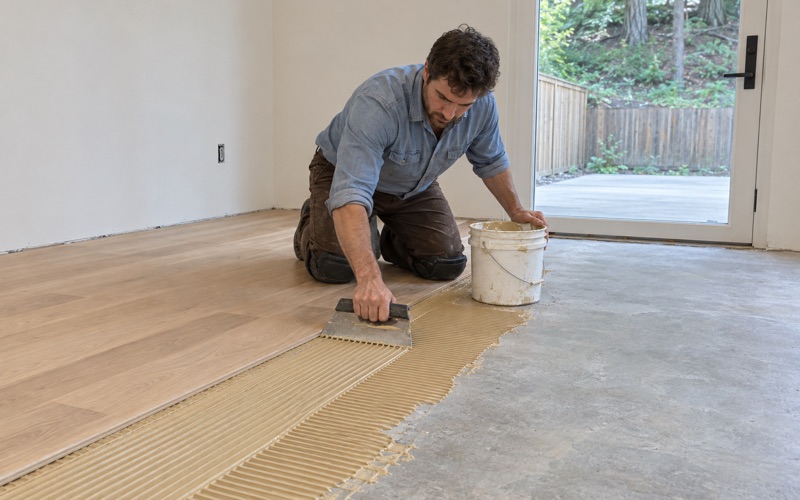
Our jobs in a Fairburn home cover sanding and refinishing site-finished floors, replacing damaged boards, reworking stair treads and installing new solid or engineered flooring. Before any of it starts, we look at what is actually on the floor, how much wood or wear layer is left and whether moisture is involved, because those three answers decide between a refinish and a replacement.
There is also something particular to this city that shapes how we set up a job site. A large part of Fairburn sits on land its own planners mapped as drinking-water watershed, so every project we run here keeps sanding dust, leftover finish and rinse water contained indoors and hauled away with us, never washed toward the curb.
Fairburn’s Drinking-Water Watersheds and the Homes Built on Them

What the City’s Own Plan Recorded
Fairburn’s comprehensive plan, in the community assessment the city submitted in November 2005, states that the entire area south of GA-29, the road known here as West Broad Street and Roosevelt Highway, falls within a water supply watershed. The same document counts three water supply watersheds crossing the city to the south and east, together totaling 2,623 acres.
At the city’s 2005 size, that came to 42 percent of Fairburn’s land. The city has annexed territory since then, so that share should not be read as a current figure. What has not changed is the geography itself: the ground south of West Broad Street is watershed land feeding a public water supply, and we treat every floor job there with that in mind.
A Building Boom Inside the Watersheds
The same 2005 plan noted that a substantial amount of new residential development was occurring inside those watershed areas. Census figures line up with that account. In the 2024 five-year American Community Survey, 68.2 percent of Fairburn’s homes were built in 2000 or later, and the single largest group, roughly 2,685 houses, went up between 2000 and 2009.
That puts a large share of the city’s floors at about the same age and the same point in their life. A site-finished oak strip floor or a prefinished plank laid during that decade has now carried two decades of traffic lanes, pet claws, dropped pans and sun fade. In many of these houses, the floor is due for its first serious attention.
Who Is Deciding About the Floor
About 64.2 percent of Fairburn homes are owner-occupied, and most of the housing is detached single-family. An owner planning a first refinish is usually weighing whether the builder-grade floor is worth keeping or whether the house would be better served by something new. We give a straight answer to that question after measuring the floor, not before.
Renters make up the rest, and some of the detached houses in town are rentals between tenants. For a landlord, the turnover calendar changes the plan more than the floor does. We talk through cure times, furniture return and move-in dates at the first visit, so the new tenant is not walking across finish that has barely set.
Looking for wood-flooring closer to Vinings? See Wood-Flooring in Vinings.
Streams, Floodplain and Storm Drains
Stream Miles and Flood Zone Acreage
The 2005 plan also counted roughly 28 miles of streams and waterways within the city limits of that time, along with about 220 acres inside the 100-year flood zone. We do not assume any particular street or subdivision sits in that zone, and we will not tell you that yours does. What those numbers show is how many places water moves through Fairburn.
The same plan mapped about 23 percent of the 2005 city as groundwater recharge area, where rain soaks down rather than running off the surface. Put the watersheds, the stream miles and the recharge zones together and the picture is a city where whatever lands on the ground rarely stays where it was dropped. That is the practical backdrop for how we clean up.
Where a Catch Basin Leads
The city’s storm sewer inventory in that document listed 25 miles of line and 1,383 catch basins. A catch basin at the end of a driveway is built to move rainwater away quickly, not to treat it. Anything poured into one travels toward the same streams the watershed maps were drawn around, whether it is clean water or a bucket of finish rinse.
That is why we never rinse an applicator, a sanding pad or a mop bucket at the curb or on a driveway during a Fairburn job. Rinse water goes into sealed containers on the truck and leaves with us. The same goes for the water used to clean tools and trays at the end of each working day, even when it looks nearly clear.
Watching the Forecast on Finishing Days
Fairburn falls in the National Weather Service’s South Fulton forecast zone, and we check that forecast before scheduling a coat of finish. A heavy afternoon storm raises indoor humidity and slows drying. It also tempts a rushed crew to open the garage and hose gear down outside, which is exactly the habit we refuse to fall into.
When a storm is due, we time finish coats around it, run a dehumidifier where the house needs one and keep all cleanup inside. A day’s delay costs far less than a coat that dries cloudy or soft. It also costs less than a bucket of residue that runoff carries from a driveway into the gutter and on toward the nearest stream.
Finishing Floors Without Sending Waste Downstream
Keeping Sanding Dust Contained
Sanding a floor for the first time removes the original finish and a thin skin of wood, and that dust carries old coating with it. We run the drum sander and orbital sander with dust collection attached, empty bags into sealed contractor sacks and vacuum between each step of the grit sequence rather than sweeping piles toward a door.
Nothing gets shaken out on the lawn or blown off the porch with a leaf blower. Fine dust that settles on a driveway washes into a catch basin with the next rain, so the cleanest approach is simply never letting it outside. Sealed sacks go in the truck, and the room is vacuumed again before the first coat of finish goes down.
Choosing and Handling the Finish
Most first refinishes in these houses use a waterborne polyurethane, which dries quickly and keeps odor manageable in a home that stays occupied. Some owners prefer an oil-modified polyurethane for its warmer amber tone, and a hardwax oil suits a few floors. We walk through sheen level, durability and cure time with you before choosing.
Whichever product goes down, the waste is handled the same way. Leftover finish stays sealed in its can, and used applicators and rags are laid flat to dry before disposal, because oil-soaked rags can heat up on their own when bunched together. Nothing is tipped into a sink, a toilet, a yard or a storm drain at any stage of the job.
Stain Samples and Water Popping
If you want a new color, we lay stain samples on your own floor, in your own light, before anything is chosen. Water popping, which raises the grain so stain takes more evenly on oak, uses only a light pass of clean water, and the cloths and buckets from that step are handled exactly like finish waste.
It can sound like a lot of care for a small amount of liquid. Multiply it across every floor job in a city with this much watershed land, though, and the habit earns its place. We would rather carry an extra container out to the truck than leave any trace of a project in the gutter out front.
The First Refinish or Replacement in a 2000s Fairburn Home
Refinish, Recoat or Replace
Site-finished oak strip from the 2000s usually has enough wood above the tongue for a full sand and refinish, and we check before promising one. Prefinished plank and glue-down engineered floors are different. The factory finish and the thickness of the engineered wear layer decide whether sanding is possible at all, and some thin wear layers allow only one careful pass.
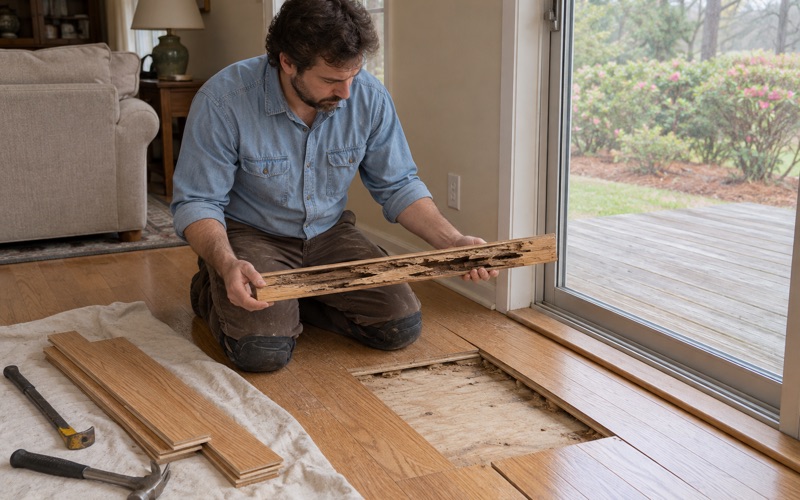
Where the wear sits only in the top coat, a screen and recoat can add years without full sanding. Where boards are gouged, stained through or loose, we move to board replacement or a new floor, and we tell you which option the floor itself supports. Pet urine stains that have soaked into the wood almost always mean replacing those boards rather than sanding them.
Moisture Before Any Sanding
A floor that is cupping in a humid Georgia summer is not ready to sand. We read it with a moisture meter, find the source, whether a leaking supply line, a dishwasher or a slow drip behind a wall, and let the boards settle before anyone flattens the edges. Sanding too early leaves a floor crowning once it dries back out.
When water has come from a washer, a dishwasher or a storm, we dry and measure each room, then document the readings room by room for your insurance adjuster. Board gapping, buckling and soft spots get the same approach. We trace the cause first, and only then decide whether the floor needs drying time, a few new boards or a larger replacement.
Stairs, Transitions and the Last Day
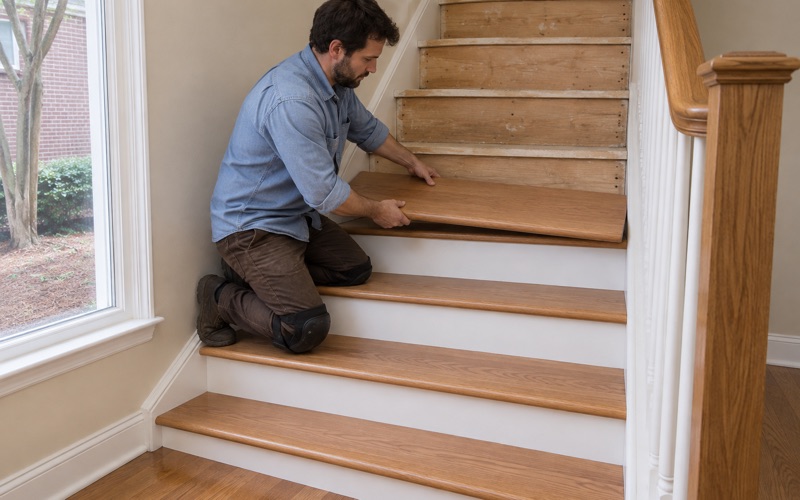
Many of these houses pair a hardwood main floor with carpeted stairs, or with oak stair treads and painted stair risers. We price stair treads one tread at a time, and we quote refinishing existing treads and installing new ones as the two separate jobs they are, so you can compare them honestly.
New reducers, quarter round and stair nosing are fitted to match the finished floor, and the house is left vacuumed and free of dust. The containment rules on the last day are the same as on the first. Every sack, can and container leaves in our truck, so the final cleanup never ends up at the curb or in the catch basin down the street.
- 20+ Years on Wood Floors
- Moisture Readings Before Repairs
- Stain Samples on Your Floor